Human Resource Assistant Chatbot Pilot Project
The Human Resource Assistant chatbot (HRA) is designed exclusively for internal University Human Resources (UHR) staff. It is one part of HR’s broader AI initiative to build a comprehensive ecosystem of AI-based tools that strengthen our ability to support the employee work experience.
The chatbot’s knowledge base contains official HR policies, best practices, general information, and forms sourced from UHR’s website, SharePoint sites, presentations, and ICON courses. By consolidating these resources into one searchable interface, HR professionals can quickly find information without navigating multiple systems or digging through documents.
The HRA launch served as a pilot project to evaluate the chatbot technology itself, along with the implementation strategy, governance model, and structure of the project team. This approach allowed UHR to test in a real-world use case, identify process and content improvements, and inform the development of a sustainable framework for future AI chatbot rollouts across campus.
Project Team:
Julie Cunningham, Senior HR Director, ITS, HR Chatbot Project Lead
Kirsten Morris, Instructional Services Specialist, Organizational Effectiveness, HR Chatbot Implementation Co-lead
Nichole Singer, Project Manager, Organizational Effectiveness, HR Chatbot Project Manager
Goals
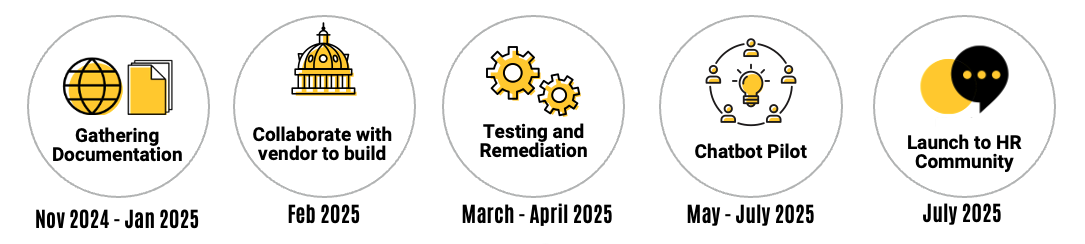
Timeline
December 2024 - August 2025
Alignment
Goal #1: Alignment

Question responses align across Orgs, Units, and HR Professionals
Efficiency
Goal #2: Efficiency

Information from multiple resources accessible in one place.
Accuracy
Goal #3: Accuracy

Information provided from the most up-to-date sources.
Strategic Benefits to the Human Resources Community
Improved Efficiency and Accuracy
The Human Resource Assistant (HRA) streamlines responses to routine HR inquiries, reducing time spent searching for information across multiple platforms. It provides as consistent and accurate answers as possible by pulling from a centralized, curated knowledge base of HR policies, procedures, and forms. Unlike general-purpose AI tools, HRA uses retrieval augmented generation (RAG) to provide answers strictly based on vetted internal documentation. This ensures reliability and avoids misinformation.
Enhanced Employee Experience
The HRA is a tool used only by internal HR professionals—not by the general employee population. By giving HR staff fast, accurate answers, it enables them to provide quicker, more consistent support to all employees. This behind-the-scenes efficiency improves the overall employee experience, ensuring that hybrid, remote, and on-campus staff receive timely, more consistent, and accurate assistance.
Time Savings for HR Professionals
HRA reduces the burden on HR staff by handling repetitive questions, allowing professionals to focus on high-touch, strategic tasks.
Consistency Across Units
The HRA ensures that responses to HR questions are aligned across organizations, units, and professionals. This minimizes discrepancies and improves trust in HR communications.
Technical and Operational Advantages
Retrieval-Augmented Generation (RAG)
Unlike general-purpose AI tools, HRA uses RAG to provide answers strictly based on vetted internal documentation. This helps ensure responses are aligned with official resources and reduces the chance of errors.
Human-in-the-Loop Oversight
The HRA is continuously refined through feedback loops involving HR experts. Gaps in understanding (e.g., distinguishing maternity leave from parental leave) are identified and addressed by the project team, and now the HRA Bot Managers, who will continue participating in testing and training to help keep the chatbot's responses accurate and aligned with official resources.
Scalable and Maintainable Design
The HRA uses a deliberately small set of custom responses, which keeps the chatbot's structure simple, making it easier to maintain, update, and scale over time. By reducing the reliance on large volumes of hard-coded answers, we ensure that most information is drawn directly from vetted and up to date HR resources. This design choice, benchmarked against other HR chatbots, was found to be optimal for long-term sustainability while still allowing for targeted custom responses when necessary.
Accessibility and Integration
The HRA is securely located within the HR section of Employee Self-Service, ensuring that it is accessible only to authenticated HR professionals. Its placement within this familiar platform removes barriers to access, allowing HR staff to find it quickly without navigating unfamiliar systems. In addition, the chatbot meets WCAG 2.1 AA accessibility standards, reflecting our commitment to providing equitable access to information for all HR professionals, including those using assistive technologies. By combining secure, role-based access with adherence to accessibility regulations, the HRA ensures that accurate, vetted HR information is both protected and readily available to those who need it.
HRA Pilot Project Key Takeaways
What Worked Well
The HRA chatbot launch showed that a focused, collaborative approach can deliver meaningful results for the HR community. Several factors contributed to its success:
- On-Time Delivery: Staying aligned with the original rollout schedule built trust and kept momentum strong.
- Content Improvements: Identifying and addressing documentation gaps strengthened HR resources and improved the quality of information available.
- Audience-Specific Training: Delivering 19 targeted sessions ensured each group received relevant, practical guidance.
- Collaborative Development: Ongoing engagement with sponsors, stakeholders, and Bot Managers helped shape the tool to meet real HR needs.
- Iterative Refinement: Continuous feedback and usability testing improved the chatbot’s performance—so much so that the vendor adopted some enhancements for wider use.
The combination of timely execution, strengthened content, focused training, and collaborative problem-solving created a strong foundation for the chatbot’s long-term sustainability and scalability.
Challenges
- Complex and Unique Questions: During testing and early rollout, incoming questions required frequent review by the project team to verify accuracy and identify gaps in the chatbot’s knowledge or supporting documentation. Notably, there were little to no repeat questions, creating a unique challenge in both refining the chatbot’s responses and ensuring its knowledge base could address a constantly changing set of inquiries.
- Adoption Impact: Usage patterns and the quality of feedback were directly influenced by the university’s overall readiness to adopt AI tools. Understanding AI literacy in the HR community highlighted the need for training focused on the development of skills in how chatbots work, when to use them, how to interact with them effectively, and how to interpret their results.
- Content Quality and Accessibility: The chatbot can only access and use content from documents that meet accessibility standards. Before the HRA could be fully trained, UHR needed to revise and correct certain materials to ensure they were complete, well-structured, and accessible. High-quality, accessible content is essential for generating accurate and useful responses.
Summary of Impact and Ongoing Improvement
Overall, the HRA chatbot initiative is demonstrating strong progress toward its intended outcomes of improving efficiency, user confidence, and documentation quality. Usage metrics from the Admin Portal indicate growing adoption, with an increasing number of unique and repeat users, signaling both initial engagement and sustained confidence in the tool’s value. Positive feedback trends suggest improving perceptions of accuracy and usefulness, while ongoing content and documentation enhancements are reducing the need for remediation and strengthening best practices among subject matter experts. To maintain these gains, the chatbot will need to be continually monitored and adapted as user needs and usage patterns evolve. Continuous performance tracking, proactive communication, vendor collaboration, and targeted response optimization will ensure the tool continues delivering measurable time savings and operational benefits across University Human Resources.
Need Help
Need Help?
If you have questions about how to get started or would like some advice on how AI can assist you with work tasks, please contact the AI Support Team.
We’re here to support your success with AI-powered tools at the University of Iowa!
AI Resources
For additional information on AI tools and AI guidelines here at the University of Iowa, check out the resources below: